
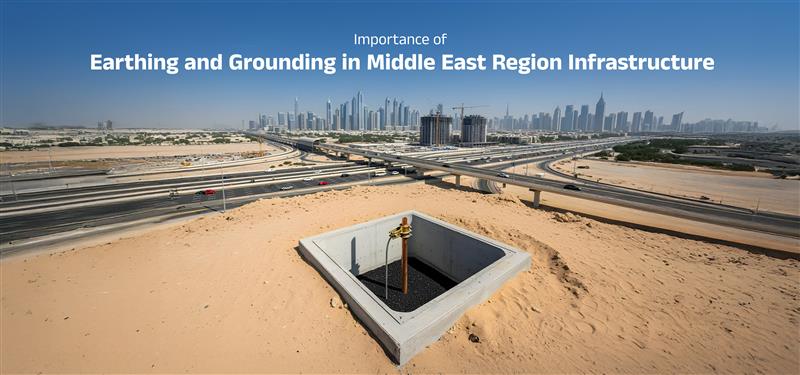
In the Middle East, engineers often start earthing design by understanding the ground first. Experience has shown that soil conditions play a key role in how grounding systems perform. What was once treated as a routine electrical requirement has evolved into a strategic engineering decision with direct implications for safety, reliability, and business continuity. Beneath the surface, desert soils rich in salts and minerals interact with extreme heat and seasonal shifts in moisture, influencing how fault currents dissipate and how grounding systems age. When earthing and grounding are designed with an understanding of this soil behaviour, they do far more than prevent electric shock.
They stabilize sensitive electronic systems, reduce electromagnetic interference, safely channel lightning energy, slow corrosion of buried assets, and help mission-critical facilities operate without disruption. But when local soil science is ignored, even a standards-compliant grounding system can underperform. In this region, effective earthing and grounding are not defined by installation alone, but by how well the design responds to the earth itself.
Why Earthing and Grounding Are Board-Level Risk Factors?
In desert and coastal construction environments, the earthing importance escalates due to extreme resistivity variation, aggressive soil chemistry, and high lightning density. Poor grounding system performance directly impacts:
- Electrical safety of personnel
- Lightning impulse current dissipation
- Surge protection coordination
- Corrosion acceleration of buried metals
- Power quality and EMI stability
- Insurance exposure and regulatory liability
For oil & gas operators, grounding failure can lead to hazardous potential rise at tank farms, pipeline flanges, and control rooms. In large industrial buildings even a marginal increase in earth resistance can create reference instability, leading to abnormal currents, surge miscoordination, and unplanned system shutdowns.
This is why earthing and grounding is no longer an installation decision. It is a strategic infrastructure reliability decision.
Dominant Soil Types Controlling Earthing and Grounding Performance in Middle East Region

The electrical behavior of any grounding system in the Emirates is governed by four primary soil categories:
- Aeolian dune sands dominate inland regions. These soils exhibit extremely high dry resistivity and rapid seasonal fluctuation, making conventional earthing systems unstable without enhancement.
- Coastal sabkha soils contain high chlorides and sulfates with permanent moisture. While initial earth resistance may appear low, long-term corrosion severely degrades electrodes and bonding networks.
- Carbonate duricrust layers consist of weak limestone and cemented sands. These layers restrict vertical current dissipation and require deep or chemically enhanced grounding
Each of these conditions directly affects earthing benefits and determines whether earthing compounds become mandatory rather than optional.
How Soil Minerals and Poor Grounding Create Electrical Risks
At the microscopic level, the minerals within UAE soils dictate conductivity, moisture retention, and corrosion potential. Quartz-rich sands are electrically inert and raise grounding system resistance. Carbonate minerals such as calcite and dolomite restrict ionic mobility. Gypsum and anhydrite introduce sulfates that accelerate corrosion. Halite introduces chlorides that destabilize electrode metallurgy and bonding joints. Clay traces influence moisture retention but remain highly variable under desert thermal cycling.
Without aligning earthing compounds with this complex mineral chemistry, even well-designed grids suffer long-term degradation. When earthing and grounding are not adapted to local soil behavior, the electrical risks extend far beyond elevated earth resistance. These include:
- Inadequate lightning surge dispersion
- Dangerous step and touch voltage gradients
- Stray current circulation into pipelines and cable sheaths
- High-frequency EMI propagation
- Ground reference instability for SCADA and protection relays
Seasonal resistivity drift due to humidity variation further destabilizes grounding system performance.
From Single Earth Pits to Complete Earthing and Grounding Ecosystem
Modern infrastructure no longer depends on isolated earth pits; it requires a complete and engineered earthing and grounding ecosystem. This ecosystem includes integrated grounding grids, parallel earth returns paths, carbon- and graphene-based earthing compounds, conductive backfills, corrosion-resistant electrodes, moisture-retention envelopes, and digital earth-resistance monitoring systems. In high-risk zones, the benefits of earthing are sustained only when these compounds and components are engineered as part of the civil–electrical interface rather than added later as superficial accessories.
Mandatory Soil Testing for Earthing and Grounding Design Approval
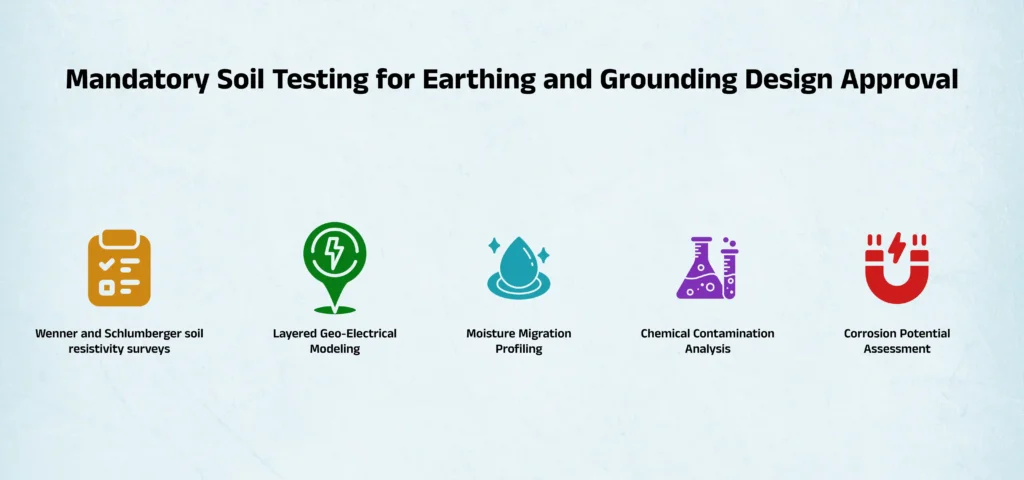
Before any high-value grounding system is approved, the following tests become mandatory:
- Wenner and Schlumberger soil resistivity surveys
- Layered geo-electrical modeling
- Moisture migration profiling
- Chemical contamination analysis
- Corrosion potential assessment.
Where natural resistivity exceeds safe limits, engineered improvement is required. This includes soil replacement, bentonite infusion, carbon-based earthing compounds, conductive concrete foundations, deep vertical electrodes, and moisture stabilization trenches. These interventions convert hostile desert soil into a controlled grounding medium capable of delivering long-term earthing benefits.
These tests directly determine the selection, quantity, and placement of earthing compounds.
Corrosion Engineering for Buried Earthing and Grounding Systems in High-Salinity Soils
Corrosion control is inseparable from grounding system performance. Cathodic protection, sacrificial anodes, conductive bonding materials, corrosion monitoring sensors, and sealed joint protection are essential in sabkha and reclaimed soils. Without these measures, earthing compounds lose effectiveness within a few monsoon cycles.
The Financial and Legal Consequences of Poor Earthing and Grounding Design
The importance of earthing becomes most visible during system failure. Inadequate earthing and grounding leads to transformer failures, repeated feeder tripping’s, relay misoperations, surge arrester burnout, SCADA damage, insurance claim escalation, unplanned downtime, and regulatory penalties. For tall buildings, even minutes of grounding instability can translate into significant revenue loss and SLA violations.
Global grounding compliance is governed by IEEE and IEC 60364. Inadequate testing, misinterpreted soil data, or incomplete commissioning exposes EPC contractors and asset owners to long-term liability, especially when buried earthing compounds fail prematurely.
Ensuring Safety and ESG Compliance through Deep Earthing in Tall Structures
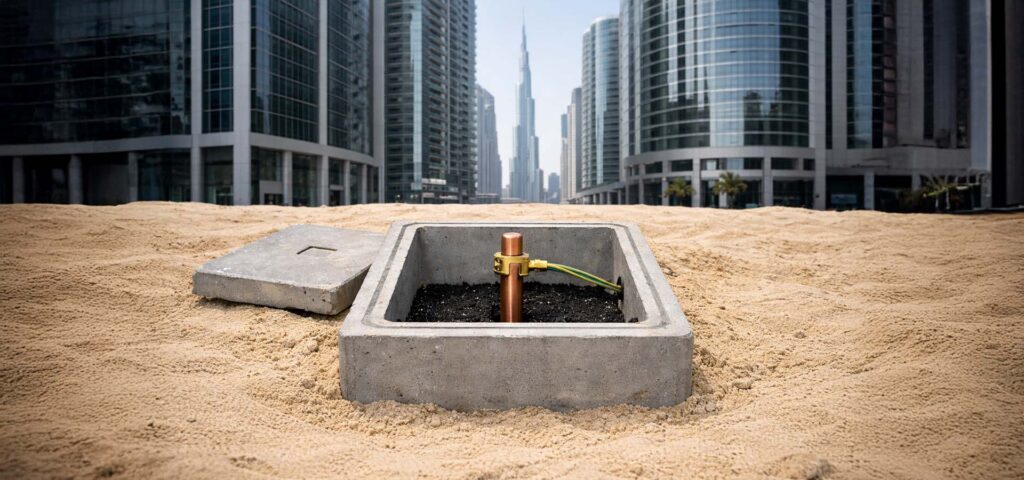
Earthing importance is deeply connected to ESG accountability. Step and touch voltage incidents threaten public safety. Chemical misuse of earthing compounds impacts groundwater. Lightning protection failures expose urban populations. ESG-aligned infrastructure now mandates environmentally stable earthing and grounding solutions with documented life-cycle performance.
Extreme vertical development imposes unique constraints on grounding system behavior. The foundation strategy of Burj Khalifa demonstrates how structural depth, carbonate rock, and layered soil conditions require multi-depth grounding integration, piled raft electrical bonding, and staged borehole validation. Without deep earthing and grounding continuity, tall towers remain vulnerable to lightning current concentration at foundation interfaces.

Conclusion
In Middle East Region soil mineral complexity makes generic grounding system design obsolete. Long-term earthing benefits are only realized when soil science, mineral chemistry, corrosion engineering, earthing compounds, and digital monitoring operate as one integrated electrical safety ecosystem.
Manav’s Earth Enhancing Compounds (EEC) support this combined approach by delivering consistent conductivity in challenging soil conditions. Designed to perform reliably despite changes in moisture and mineral composition, these compounds help maintain low earth resistance, minimize corrosion, and improve the long-term stability of grounding systems. As climate patterns continue to evolve, such engineered solutions strengthen electrical safety and resilience across critical infrastructure.
– Author: Pankaj Dixit