
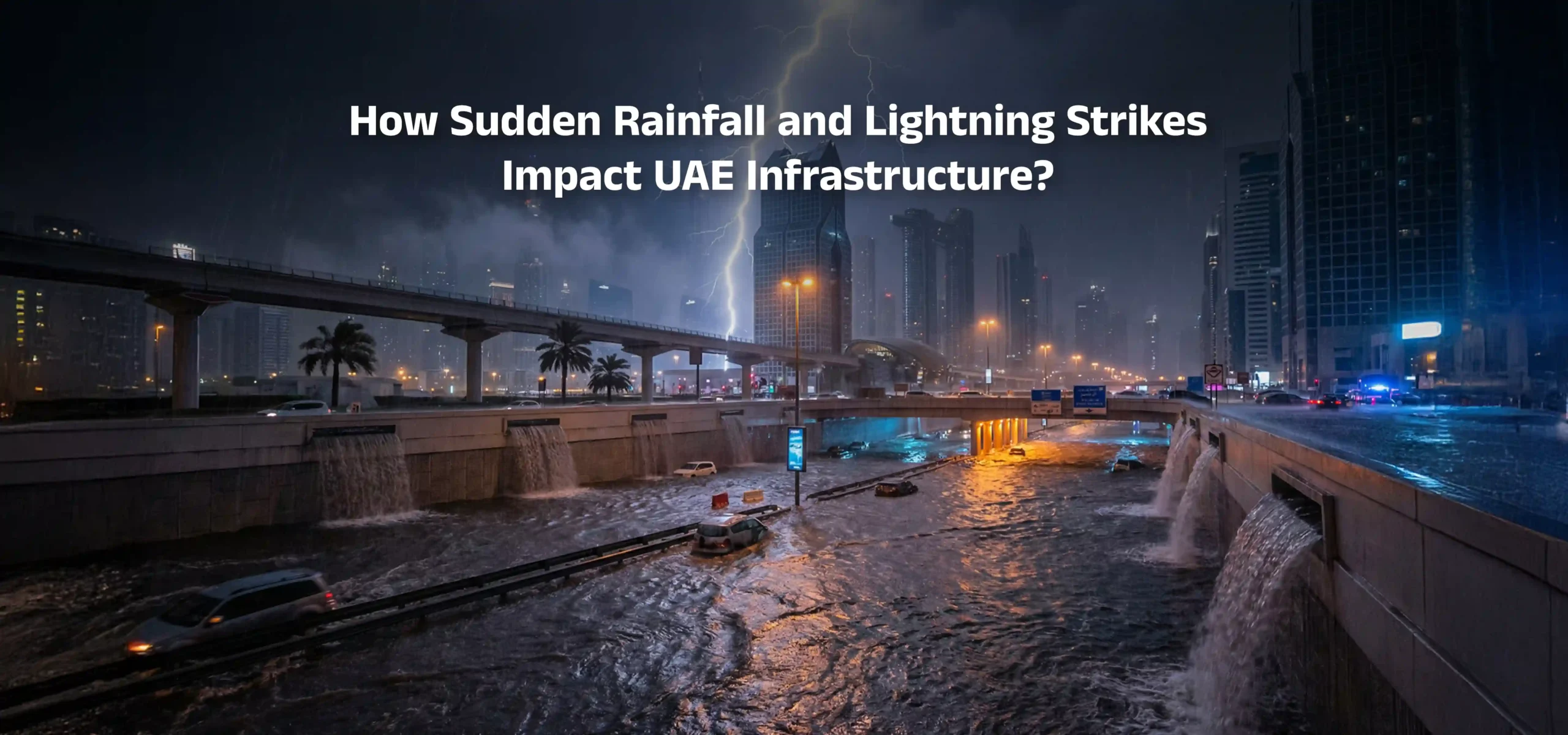
The afternoon sky over Dubai felt strange, too quiet, too heavy. The Burj Khalifa stood tall against clouds that had darkened into an uneasy shade of purple. In a city known for clear skies and blazing sun, this sudden shift felt like a warning with a fear of lightning strike thundering and roaring all over Dubai.
Then what exactly happened?
Lightning tore through the sky, followed by thunder so loud it shook windows across the city. Within minutes, rain began to pour fast, thick, relentless. Roads flooded, traffic slowed to a crawl, and familiar streets turned into streams. What felt like a rare weather event was quickly becoming the new normal.
But while the city above struggled with water and visibility, the real danger was unfolding out of sight. Power stations, data centers, and electrical networks were taking the hit. One lightning strikes near a substation was enough to send a powerful surge through connected systems. Ground already soaked with rain struggled to absorb the shock. In seconds, critical equipment was exposed, systems failed, and costly damage followed.
This is today’s reality for UAE infrastructure. Sudden rainfall and lightning are no longer occasional disruptions, they are growing risks that demand serious attention.
The Hidden Vulnerability in UAE infrastructure
While social media fills with footage of flooded malls and stalled supercars, the real damage happens where the eye can’t see.
The sudden rainfall and lightning events experienced across Dubai in December were not just urban inconveniences. They directly impacted industries, utilities, and large commercial structures that form the backbone of the city’s economy. High-rise buildings, industrial plants, data centres, airports, and logistics hubs were exposed to electrical stress as intense rainfall altered ground conditions and increased lightning activity across vast areas.
In UAE infrastructure, large buildings and industrial facilities, the consequences go far beyond temporary power loss. Lightning-induced surges can affect building management systems, fire alarm networks, elevators, access control, and critical process equipment. Industrial operations face production interruptions, data corruption, equipment degradation, and safety risks when protection systems fail to respond effectively under changing environmental conditions.
These events have highlighted a growing gap between traditional protection design and modern infrastructure needs. Many earthing and lightning protection systems were installed based on static assumptions, while today’s buildings are taller, more interconnected, and far more dependent on sensitive electronics. When rainfall rapidly changes soil resistivity, grounding effectiveness can drop precisely when large structures need it most.
To address this, the industry is increasingly adopting advanced engineering solutions, such as adaptive earthing systems, enhanced lightning-interception design for high-rise structures, intelligent surge protection devices, and continuous monitoring of grounding performance. For cities dominated by iconic towers and critical industrial assets, resilience now depends on how well protection systems evolve alongside architectural ambition and technological complexity.
The Shield: Manav’s Lightning Protection System (LPS)
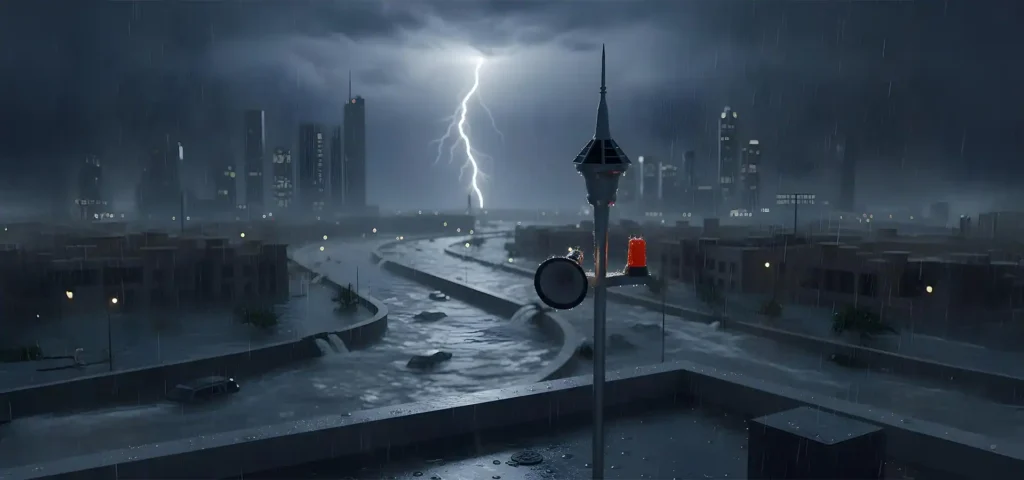
As the storm rages outside, a different scene unfolds at a major utility plant on the outskirts of Abu Dhabi. Here, the air is just as charged and the rain just as heavy. But while other sites scramble to manage power trips, this facility remains operational, its systems stable and its hardware safe.
The difference is the integration of Manav’s Lightning Protection and Earthing Solutions.
Manav understands that, protecting a structure requires more than just a copper rod on a roof. Their approach is based on advanced engineering designed specifically for the unique geological and climatic challenges of the Middle East.
The electrical behavior of any grounding system in the Emirates is governed by four primary soil categories:
- Dynamic Earthing Systems: Manav’s solutions are engineered to maintain low resistance even when desert soil transitions from bone-dry to waterlogged in minutes. This ensures lightning energy is safely and instantly diverted, preventing equipment from frying due to "back-flash."
- Total Shielding: From the initial risk assessment to the installation of high-tech surge protection devices, Manav provides a 360-degree shield. They don't just protect the "shell" of a building; they protect the sensitive digital components inside.
- Future-Proof Engineering: Manav LPS serves as a critical pillar of resilience. Their systems are built to withstand the "new normal" of high-intensity lightning strikes that were once considered rare events.

Conclusion
As the clouds finally parted over the UAE Infrastructure that evening, the lesson was clear. Infrastructure is only as strong as its weakest link. In an era of sudden floods and violent skies, that link is often buried in the ground or hidden on the roof.
We cannot stop the rain, and we cannot prevent the lightning strikes. But with Manav, we can ensure that when the sky cracks, the city remains standing for protecting the UAE Infrastructure future, advanced safety measures should be implemented.
– Author: Pankaj Dixit