
Arc flash incidents are one of the most dangerous electrical hazards in industrial facilities. An Arc Flash Study is a systematic engineering analysis that helps identify, quantify, and reduce these risks, directly preventing serious accidents, injuries, and equipment damage. Electrical power systems are fundamental to industrial operations, utilities, infrastructure, and renewable energy facilities. However, these systems also present severe electrical hazards, with arc flash incidents being among the most dangerous. An arc flash event can result in extreme thermal energy, explosive pressure waves, equipment destruction, and life-threatening injuries.
An Arc Flash Study, integrated within comprehensive Power System Studies, provides a scientific and analytical framework to quantify electrical hazards, optimize protection systems, and prevent electrical accidents. These studies are not only regulatory requirements under standards such as IEEE 1584 and NFPA 70E but are also essential engineering tools for operational safety and reliability.
Fundamentals of Arc Flash Phenomenon
1. Mechanism of Arc Formation
An arc flash occurs when an electrical fault allows current to travel through ionized air between conductors or from conductor to ground. This typically results from insulation failure, equipment degradation, contamination, improper maintenance, or human error. Once initiated, the arc sustains itself due to plasma formation, producing extremely high temperatures and radiant heat.
The arc temperature can exceed 19,000°C, causing metal vaporization and rapid expansion of air. This expansion generates a pressure wave known as arc blast, which contributes to mechanical injury and structural damage.
2. Governing Electrical Parameters
The severity of an arc flash is determined by several interdependent electrical variables. The available short circuit current defines the maximum potential energy source feeding the arc. The arcing current, calculated using IEEE 1584-2018 models, determines the actual current flowing during the arc condition. Clearing time, defined as the duration required for protective devices to interrupt the fault, directly influences incident energy magnitude.
Working distance impacts exposure level, while system voltage and grounding configuration affect arc stability and fault current magnitude. The system X/R ratio also influences asymmetrical fault current and peak current contribution.
3. Thermal and Mechanical Impact
Incident energy, expressed in cal/cm², quantifies the thermal energy exposure at a specific working distance. Arc flash boundary defines the distance at which incident energy reduces to 1.2 cal/cm², the threshold for a second-degree burn. Beyond thermal hazards, arc events generate high-pressure waves and intense sound energy, capable of causing blunt force trauma and hearing damage.
Arc Flash Study Methodology
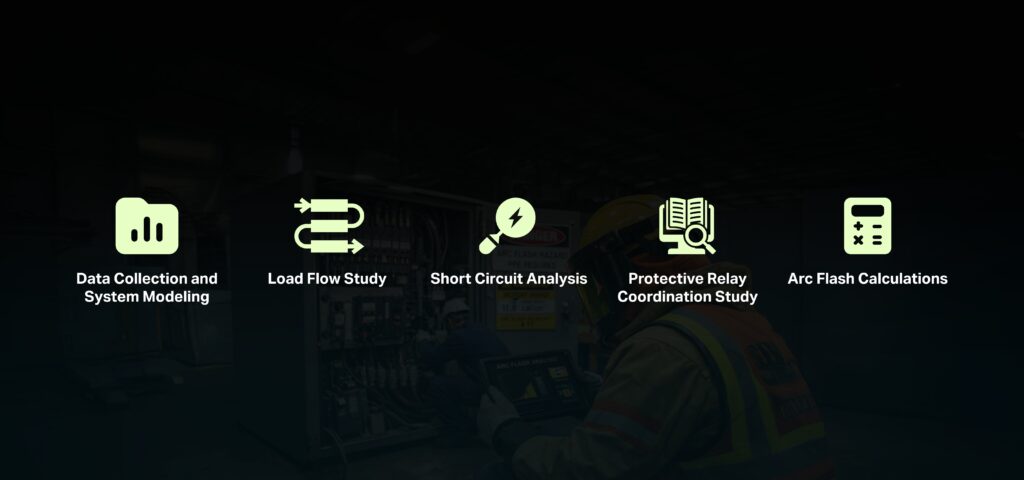
1. Data Collection and System Modeling
The first stage of an Arc Flash Study involves detailed system data acquisition. Engineers collect updated single-line diagrams, transformer ratings and impedance values, utility fault contribution data, generator subtransient reactance, conductor impedance parameters, and protective device settings.
Using advanced simulation software such as ETAP, SKM Power Tools, CYME, or DIgSILENT, a digital representation of the power system is created. Accurate modeling is critical, as even minor data discrepancies can significantly alter incident energy calculations.
2. Load Flow Study
A load flow study evaluates the steady-state operating condition of the electrical system under normal and peak demand scenarios. It determines bus voltages, current flows, power distribution, transformer loading, and system losses.
This analysis validates the accuracy of the system model developed during data collection and ensures that all equipment operates within permissible limits. It also establishes pre-fault operating conditions, which influence motor and generator fault contributions during short-circuit and arc flash calculations.
Any voltage deviations, overloads, or unrealistic assumptions are corrected before proceeding to short-circuit and arc flash analysis, ensuring reliable and accurate results.
3. Short Circuit Analysis
Short circuit analysis determines maximum and minimum fault current levels at each bus in the system. Both three-phase and single-line-to-ground faults are evaluated. Maximum fault conditions validate equipment interrupting ratings, while minimum fault conditions may produce longer protective device clearing times, potentially increasing incident energy.
Symmetrical and asymmetrical current calculations are performed according to ANSI or IEC standards, depending on regional practices. The results form the foundation for protective coordination and arc flash calculations.
4. Protective Relay Coordination Study
Protective coordination ensures that faults are cleared selectively and rapidly. Time-Current Characteristic curves are developed to verify coordination between upstream and downstream devices.
However, excessive time delays introduced for selectivity can increase arc flash energy. Therefore, optimization is required to balance system reliability and safety. Techniques such as zone selective interlocking, differential protection schemes, and maintenance mode settings are often implemented to reduce clearing time without compromising selectivity.
5. Arc Flash Calculations
Using IEEE 1584-2018 equations, arcing current is calculated based on system voltage, fault current, enclosure size, and electrode configuration. Incident energy is then computed for each bus under worst-case conditions.
The study determines arc flash boundary, incident energy at working distance, and required Personal Protective Equipment level. Each location within the system must be evaluated under both maximum and minimum fault scenarios.
Engineering Controls for Arc Flash Risk Reduction
Reduction of Clearing Time
Voltage drop is the reduction in voltage that occurs when electrical current flows through conductors. In Voltage Drop in Power Systems, this phenomenon is unavoidable, but it must be controlled to ensure proper equipment operation. The extent of voltage drop depends on cable length, conductor size, load current, and power factor.
Industry standards specify acceptable voltage drop limits to maintain efficiency and reliability. When voltage drop exceeds these limits, equipment may continue operating but under stressed conditions. Over time, this results in higher losses, increased heating, and reduced equipment life. Understanding this behaviour requires proper analysis, which is provided by a Voltage Drop Study.
Zone Selective Interlocking (ZSI)
ZSI allows downstream breakers to clear faults instantaneously while maintaining coordination with upstream devices.
This reduces arc duration without sacrificing selectivity.
Differential Protection Schemes
Bus differential and transformer differential protection detect faults within a defined zone and trip rapidly (typically within a few cycles), significantly limiting incident energy.
1. Current Limiting Devices
Current-limiting fuses and circuit breakers reduce peak let-through current and I²t energy during fault conditions. These devices are particularly effective in low-voltage distribution systems and motor control centers.
2. Arc-Resistant Equipment
Arc-resistant switchgear is designed to contain internal arc events and redirect energy away from personnel. While it does not reduce incident energy at the source, it enhances worker protection during fault conditions.
3. Grounding System Optimization
Grounding configuration significantly affects fault current magnitude and arc sustainability. High-resistance grounding systems can limit ground fault current and reduce equipment damage. Proper grounding design also improves protective device sensitivity.
5 Role of Comprehensive Power System Studies
Arc Flash Study is one component of a broader electrical safety framework. Comprehensive Power System Studies integrate multiple analytical evaluations.

1. Load Flow Analysis
Load flow studies evaluate voltage profiles, transformer loading, generator dispatch, and reactive power compensation. Improper load distribution may influence fault contribution and protection performance.
2. Short Circuit Study Integration
Short circuit studies verify equipment duty ratings and ensure that switchgear interrupting capacity is not exceeded. They also establish baseline data for protection coordination and arc flash evaluation.
3. Harmonic Analysis in Modern Systems
Facilities incorporating variable frequency drives, solar inverters, UPS systems, and power electronic interfaces require harmonic analysis. Harmonics can cause relay misoperation and overheating, indirectly affecting protective reliability.
4. Renewable Energy Integration
The integration of inverter-based renewable resources introduces bidirectional power flow and altered fault contribution characteristics. Although inverter fault current is limited, clearing time dynamics may change, necessitating updated arc flash calculations.
Compliance and Documentation
Arc Flash Studies must comply with regulatory and industry standards. NFPA 70E mandates arc flash risk assessment and labeling requirements. IEEE 1584 defines calculation methodology. OSHA enforces workplace electrical safety compliance.
Equipment labeling must display nominal system voltage, arc flash boundary, incident energy at working distance, and PPE requirements. Studies must be updated whenever system modifications occur, including transformer upgrades, additional feeders, or renewable integration.
Lifecycle Safety Management
Electrical systems evolve over time. Arc Flash Studies must be periodically reviewed to ensure accuracy. Any change in utility contribution, equipment rating, protection settings, or load expansion may alter fault levels and incident energy.
Failure to update studies exposes personnel to unidentified hazards and may invalidate compliance documentation.

Conclusion
Arc flash studies play a critical role in identifying and reducing electrical hazards in industrial systems. By accurately analyzing system behavior and applying effective engineering controls, arc flash incident energy can be significantly minimized.
A well-executed study enhances personnel safety, ensures standards compliance, protects equipment, and reduces operational risk, making it an essential component of modern electrical system design and maintenance.
– Author: Vigneshwaran S