
Neutral Earthing Resistors (NERs) are critical components in medium-voltage power systems, designed to limit ground fault current to safe and controlled levels. By restricting fault magnitude, NERs reduce mechanical and thermal stress on transformers, generators, and switchgear while enabling effective Ground Fault Protection.
When properly engineered and coordinated, Neutral Earthing Resistors enhance overall Electrical System Protection and significantly reduce arc flash energy during single line-to-ground faults. However, when operating outside their design parameters, overheating can occur, leading to insulation degradation, resistance drift, and potential system instability.
Understanding why NER overheating happens, and how to prevent it, is essential for maintaining reliable and safe network operation.
Operational Principles
Neutral Earthing Resistors are connected between the neutral point of a transformer or generator and earth. During a single line-to-ground fault, the resistor carries a predetermined current for a specified time duration, typically 10 seconds or 30 seconds depending on system design.
This controlled current limitation allows protective relays to detect and isolate faults rapidly, supporting selective Ground Fault Protection while preventing excessive damage to equipment.
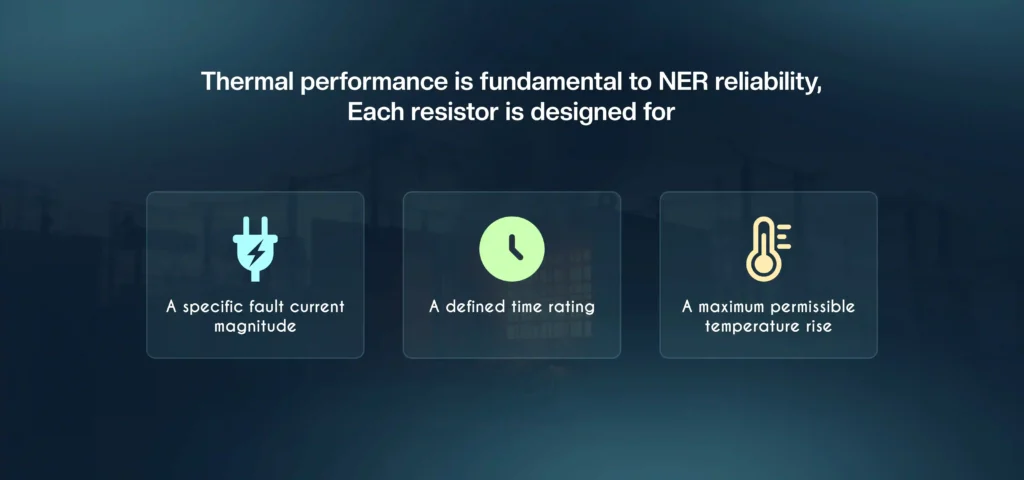
If these limits are exceeded, overheating can occur, compromising both resistor integrity and overall Electrical System Protection.
Primary Causes of Overheating
Extended fault duration is one of the leading contributors to NER Overheating. If relays or breakers fail to clear faults promptly, Neutral Earthing Resistors remain energized longer than intended. Continuous exposure to high temperature accelerates deterioration and compromises Electrical System Protection.
System expansion without recalculating fault levels can also result in NER Overheating. As transformers or generators are added, available fault current increases. If Neutral Earthing Resistors are not resized accordingly, excessive heat generation becomes inevitable.
Environmental Influences
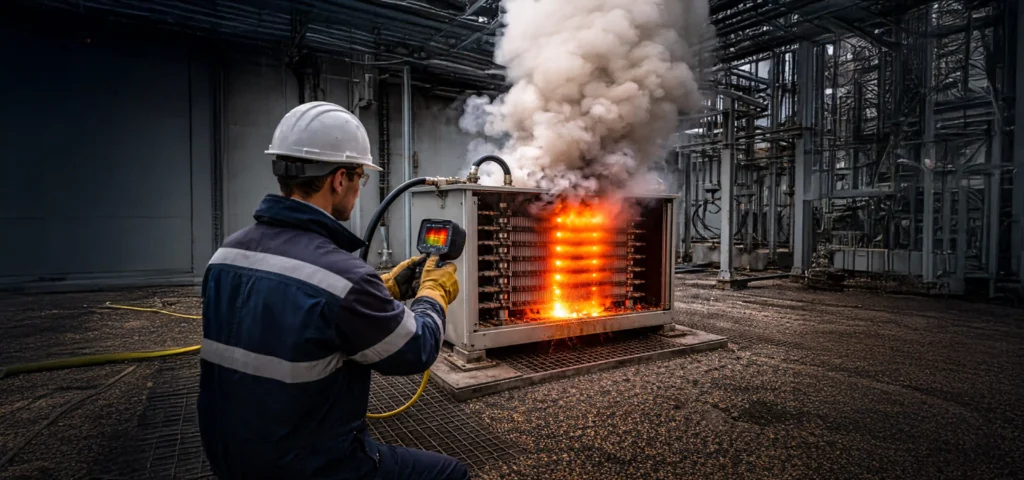
Ambient temperature and ventilation conditions significantly influence Neutral Earthing Resistors performance. Poor airflow reduces cooling efficiency and increases internal temperature rise. In harsh industrial settings, dust accumulation can restrict heat dissipation and intensify NER Overheating.
Moisture and corrosion further affect resistor integrity. Preventive inspection strengthens Electrical System Protection by identifying environmental stress before failure occurs.
Impact on Protection Coordination
When NER Overheating alters resistance value, Ground Fault Protection settings may no longer operate as designed. Incorrect fault current magnitude affects relay sensitivity and selectivity. Consequently, Electrical System Protection may weaken, increasing operational risk.
Maintaining stable resistance ensures consistent Ground Fault Protection. Neutral Earthing Resistors must therefore be monitored to guarantee accuracy under varying system conditions.
Continuous Neutral Current and Harmonics
Unbalanced load conditions can create small persistent neutral currents. Over time, this may contribute to NER Overheating if not considered during design evaluation. Harmonic components from nonlinear loads introduce additional stress on Neutral Earthing Resistors.
Comprehensive system analysis ensures Electrical System Protection remains intact despite these complexities. Detailed modeling verifies that Ground Fault Protection schemes align with actual operating characteristics.
Preventive Engineering Measures
Preventing NER Overheating begins with accurate short‑circuit analysis and protection coordination studies. Engineers verify that Neutral Earthing Resistors match maximum prospective fault current. Coordinated relay timing limits exposure duration and enhances Ground Fault Protection.
Thermal monitoring and periodic resistance testing provide early warning of abnormal conditions. Modern installations integrate sensors that alert operators before NER Overheating escalates. Such measures strengthen Electrical System Protection and extend service life.
Strategic Review During System Upgrades
Whenever facilities expand capacity or modify network configuration, Neutral Earthing Resistors must be reassessed. Updated calculations confirm compatibility with new parameters. This proactive approach prevents NER Overheating and maintains reliable Ground Fault Protection.
Electrical System Protection depends on alignment between equipment ratings and network behavior. Reviewing Neutral Earthing Resistors during every modification ensures sustained performance.

Conclusion
Neutral Earthing Resistors are vital safeguards in medium-voltage power systems. They limit fault energy, reduce equipment stress, and support coordinated Ground Fault Protection.
NER overheating typically results from extended fault duration, increased fault levels, environmental constraints, or inadequate system review. Preventing it requires accurate sizing, coordinated protection settings, environmental control, and continuous monitoring.
By treating Neutral Earthing Resistors as strategic components rather than passive devices, facilities can strengthen Electrical System Protection, enhance safety, and ensure reliable industrial operation.
– Author: Vigneshwaran S