
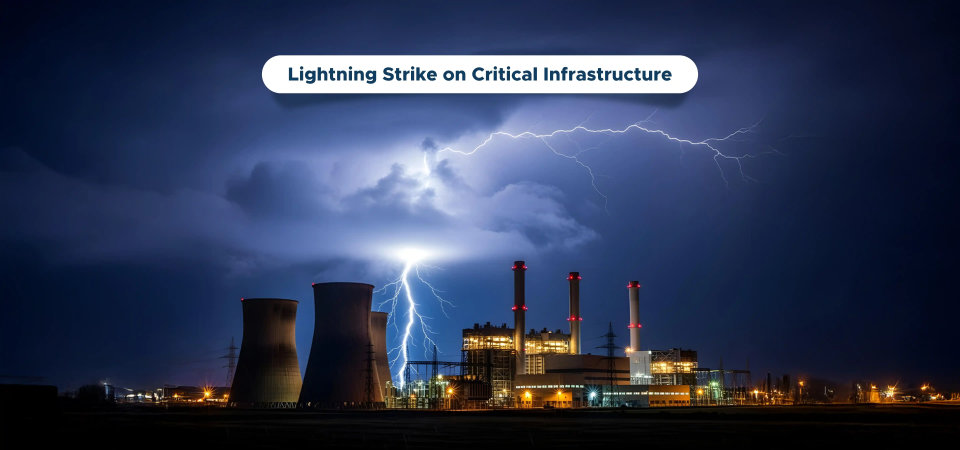
As we know, one uncontrolled surge is all it takes to turn stability into shutdown . At 2:14 AM, a sudden lightning strike hit a district-level substation.
Within milliseconds, breakers tripped; alarms erupted through the SCADA room, and thousands of homes were pushed into darkness.
What made the incident more concerning was this:
Earlier that night, atmospheric sensors had already begun registering abnormal storm activity, but not every critical infrastructure has intelligent systems that can act before a strike occurs.
This event isn’t an exception. It represents a growing pattern.
According to the IMD, India recorded 2.57 crore lightning strikes between 2024 and 2025, a staggering 170% increase in just five years.
Such a rise puts enormous stress on the nation’s essential systems, from substations and railways to airports, data centers, and telecom networks. The sudden energy of a lightning strike is no longer a rare weather disturbance; it is now one of the fastest-growing threats to critical infrastructure protection and power system reliability.
These surges and impulse currents don’t just knock out equipment. They expose deeper vulnerabilities, gaps in grounding, missing early warning systems, ageing protection devices, and insufficient critical infrastructure security frameworks. As India’s grid becomes more interconnected and digital, even a single lightning-induced failure can cascade across systems, multiplying losses and downtime. This is why understanding lightning, its impact, and the engineering needed to counter it is now more urgent than ever.
What is a Lightning Strike Really?
A lightning strike is often seen as a bright flash in the sky, but in engineering terms, it is one of the most extreme electrical events found in nature. Within a fraction of a second, a charged cloud discharges a massive current, often 30,000 to 200,000 amperes, straight into the ground or into structures standing in its path.
The physics behind it is violent and incredibly fast.
A lightning channel forms when the electric field between cloud and earth becomes so strong that air breaks down and turns conductive. The current then rises in microseconds, creating a steep wavefront known as an impulse current. This sudden discharge generates powerful electromagnetic fields, radiating outward and coupling into metallic structures, power lines, signal circuits, and even buried cables.
This is where the real risk begins.
A lightning strike doesn’t need to hit equipment directly to cause damage. The electromagnetic pulse can induce dangerous voltages in nearby conductors, create back flashovers, or push surge currents into sensitive electronic systems. Even a well-built facility can experience failures if these parameters aren’t fully understood and accounted for in design.
For engineers and operators, this is why lightning science matters. When we know how fast the current rises, how far the electromagnetic field spreads, and how high the impulse voltage climbs, we can design more reliable electrical system protection strategies. From surge arresters to bonding networks, every component depends on understanding lightning’s behaviour. It also forms the foundation of stronger critical infrastructure security.
How does Lightning Damages Critical Infrastructure
A lightning strike can damage infrastructure in four major ways, and each one threatens critical infrastructure protection differently. A direct strike delivers extremely high current, often over 100 kA, destroying transformers, insulators, and control panels instantly. Back flashover occurs when tower potential rises so fast that the energy jumps into phase conductors, causing tripping and relay misoperations.
Even when a lightning strike occurs kilometres away, induced surges can enter signalling, telecom, and data systems through electromagnetic coupling, damaging sensitive electronics. The fourth mode, line surges, sends steep impulse waves through long transmission or communication lines, stressing equipment at incredible speeds. These scenarios highlight why modern facilities depend on engineered grounding and high-quality lightning strike surge protection devices to prevent cascading outages.
Sector Wise Impact Where Failure Costs Are Highest
Different sectors experience a lightning strike differently, but the losses are consistently high.
Power & Substations
- Up to 40% of grid disturbances in Indian monsoon states are lightning-related.
- A single lightning strike can generate 250 kV impulses on 66/132/220 kV systems.
- Insulation breakdown, arrester failures, and transformer explosions are common.
This puts enormous pressure on critical infrastructure protection policies for utilities.
Railways
Railways are extremely sensitive to induced surges.
A lightning strike causes:
- Earth potential rise (EPR)
- Failures in axle counters
- Trip of signalling Logic Units (EI, SSI)
- Section-wide delays
Indian Railways reports 300+ signalling failures per year linked to lightning-induced surges, a major critical infrastructure security concern.
Airports
Airports rely on hundreds of microprocessor-based systems.
A lightning strike can cripple:
- VHF radios
- Radar systems
- Runway lights
- ADS-B receivers
Case: Heathrow experienced a surge event that disrupted 1,350 flights, highlighting global aviation vulnerability.
Data Centers
A lightning strike that bypasses grounding can cause:
- UPS failure
- Server shutdown
- Rack PDU burnout
- System-level downtime costing $100,000–$540,000 per hour
Data centers now mandate lightning strike surge protection devices at every layer.
Telecom Towers
Tallest structures → highest risk.
A lightning strike frequently damages:
- Remote Radio Units (RRUs)
- Antenna feeders
- Microwave links
- This impacts national communication reliability.
Forensic Engineering in Confirming Lightning as the Root Cause
When a lightning strike is suspected, engineers conduct a structured forensic study.
Key investigative layers:
1. IMD Lightning Map Correlation
Engineers overlay the exact time of outage with IMD’s lightning strike timestamp.
If both match within seconds → lightning confirmed.
2. Relay Coordination
Lightning-related surges show:
- Fast transient peaks
- Steep-front waveforms
- Unusual tripping sequences
- Surge-arrester counters increment
These are classic indicators used in critical infrastructure protection audits.
3. Damage Mapping
Burn marks, flashover patterns, insulation punctures, and SPD failures trace the path of the lightning strike.
4. Event Reconstruction
Helps identify gaps in:
- Grounding
- Bonding
- SPD selection
- Surge path mitigation
This strengthens critical infrastructure security frameworks for future designs.
Technical Solutions for Designing Infrastructure Resilience
Strong infrastructure protection starts with a well-designed Lightning Protection System as per IEC 62305 standards. This system uses air terminals such as rods, masts, ESE systems, and mesh conductors to capture lightning safely before it enters the structure. Down conductors carry the current toward the ground, while bonding networks and earth termination systems ensure the energy is discharged safely into the soil. Engineers use the rolling sphere method with a 20 m or 30 m radius to make sure no vulnerable part of the structure remains exposed. Surge Protection Devices then add a second layer of safety, Type 1 devices handle direct lightning energy, Type 2 manage internal surges, and Type 3 protects sensitive electronic equipment.
The earthing and grounding system forms the foundation of all this protection by providing low-resistance paths, equipotential bonding, soil enhancement compounds, and grounding grids to safely release fault currents. Since poor grounding causes nearly 70% of lightning-related failures, modern facilities also use redundancy such as shield wires, dual power feeds, fibre loop networks, and surge-isolated PLC systems to maintain continuous operation during severe storms.
How Manav Builds Future-ready Resilience With Lmas (Lightning Management and Alert System)
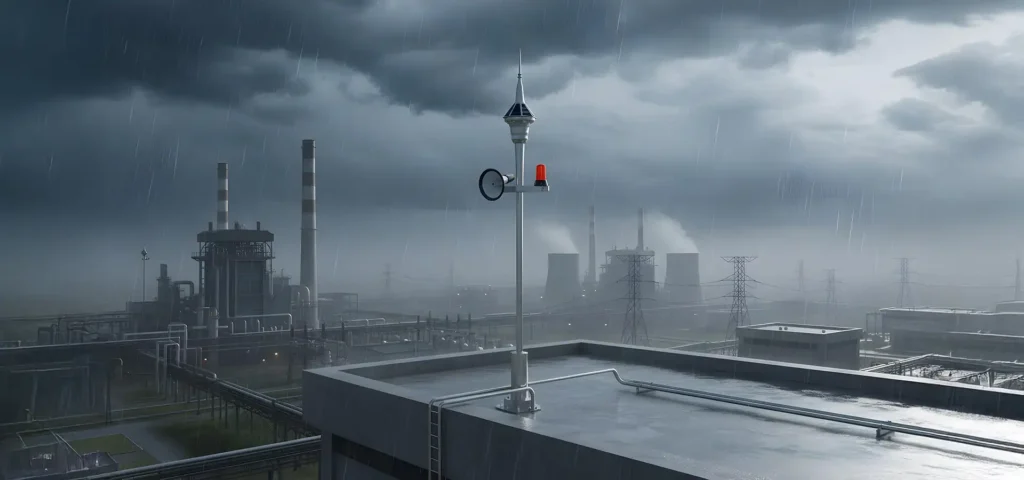
Manav strengthens industrial and utility infrastructure through its advanced LMAS, a Lightning Management and Alert System engineered for real-time predictive protection. LMAS integrates atmospheric monitoring, electric-field measurement, and intelligent early-warning algorithms to detect lightning activity before it reaches critical assets. Unlike traditional passive lightning protection, LMAS provides actionable lead time by continuously analysing charge buildup and identifying high-risk zones.
This system enables plant operators, substations, renewable energy farms, refineries, and rail or metro networks to isolate vulnerable equipment, shut down sensitive operations, and activate surge protection systems well before a strike occurs. LMAS also logs environmental and electrical parameters, helping engineers understand lightning behaviour over time and plan better grounding, surge coordination, and asset-level protection. LMAS helps industries build long-term resilience, reduce failure rates, prevent downtime, and ensure safer operational continuity.
Industry Checklist — Making Your Infrastructure Strike-ready
Preparing infrastructure for lightning hazards requires a structured, engineering-focused approach. A strike-ready facility starts with risk assessment of soil conditions, earthing performance, surge exposure points, and structural weaknesses. Regular earth resistance tests, mat audits, and bonding checks ensure safe dissipation of fault currents. All metallic structures, cable trays, and communication systems must be bonded to a unified grounding network, supported by coordinated surge protection across all voltage levels. Advanced monitoring, weather alerts, and preventive shutdown protocols enhance resilience. Updated test reports and RCA records help track deterioration. True strike-readiness comes from disciplined engineering and continuous maintenance.

Conclusion
Lightning is unpredictable, but its damage doesn’t have to be. As critical infrastructure becomes more sensitive and interconnected, real-time visibility, engineered grounding, and early-warning systems are no longer optional. With solutions like LMAS by Manav, industries can shift from reactive repairs to predictive protection, ensuring safety, continuity, and long-term resilience against lightning threats.
– Author: Niju PP