
The control room lights flickered for less than a second before going dark. Motors coasted down, alarms flooded the screens, and an industrial facility designed for continuous operation came to a sudden halt. There was no visible equipment failure, no explosion, and no human error. What failed was the electrical system’s ability to respond to a disturbance it had never been analytically prepared for.
Such events are no longer isolated. Globally, power outages and system disturbances are increasing in both frequency and impact.
In February–March 2025, India’s national grid faced frequency dips and instability when a cloud-induced rapid decline in solar generation reduced output unexpectedly, prompting the national operator to alert generators to maintain balance and prevent grid excursions. mint
At the same time, power system complexity is accelerating. Global installed generation capacity has more than doubled over the last two decades, transmission networks have expanded by millions of circuit kilometres, and renewable energy capacity has grown at double-digit rates year after year. In regions such as Asia, the Middle East, and other rapidly industrialising markets, fast grid expansion and high renewable penetration are driving more frequent system disturbances linked to protection miscoordination and unvalidated operating conditions. In this environment, Power System Analysis is no longer optional, it is a mandatory engineering discipline.
Why Power System Analysis Is Now Mandatory?
Electrical networks are operating under unprecedented stress. Global industrial electrification, digital control systems, electric mobility, and renewable integration have dramatically increased both the scale and sensitivity of power systems. According to international utility data, the economic cost of electrical outages now runs into hundreds of billions of dollars annually, with industrial facilities experiencing some of the highest losses due to unplanned downtime. A single hour of power interruption in heavy industry can translate into production losses, equipment damage, and safety incidents that far exceed the cost of proper engineering studies.
In parallel, power systems have become less predictable. Bidirectional power flows, fluctuating generation, and variable loads mean that historical design assumptions are no longer valid. Electrical networks must now be proven, not assumed, to operate safely. This is why Power System Analysis is increasingly required by utilities, regulators, insurers, and asset owners. It provides measurable evidence that the system can withstand faults, maintain voltage stability, and protect people and equipment across all operating conditions.
What Power System Analysis Evaluates in Modern Electrical Networks?
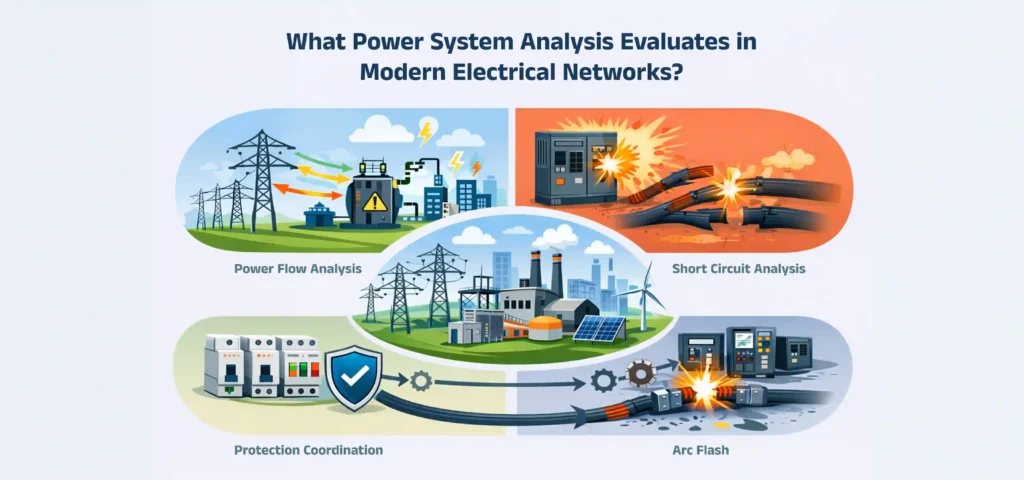
Power System Analysis evaluates how an electrical network behaves as a complete, interconnected system rather than as isolated components. It verifies whether voltages remain within acceptable limits, whether equipment operates within thermal ratings, whether fault currents stay within interrupting capacities, and whether protection systems respond selectively and correctly.
- Load Flow Study establishes how power moves through the network under different loading scenarios. It reveals voltage drops, excessive losses, transformer overloading, and imbalance issues that may not be visible during normal operation but can escalate under peak demand or contingency conditions. Without accurate load flow evaluation, systems may operate on the edge of instability without warning.
- Short Circuit Study determines the magnitude of fault currents throughout the system. As networks grow and sources are added, fault levels can increase beyond equipment ratings, creating a risk of catastrophic failure. Inadequate short circuit analysis has been repeatedly identified as a root cause of breaker failures, cable damage, and arc-flash incidents in both industrial plants and utility substations.
- Protection Coordination Study ensures that protective devices operate in the correct sequence and within defined time margins. Proper coordination prevents unnecessary outages and ensures that faults are isolated quickly and safely. Where coordination is missing or outdated, minor disturbances can escalate into widespread shutdowns or leave faults uncleared, endangering both personnel and assets.
- Arc Flash Analysis a crucial component of power system analysis focused on identifying potential hazards and ensuring the safety of personnel and equipment from the dangers of electrical explosions. Its role is both a regulatory requirement (mandated by standards like NFPA 70E and OSHA) and a proactive safety measure.
Who Is Accountable When Power System Analysis Is Missing?
When an electrical failure occurs, accountability extends far beyond the design engineer. Asset owners face production losses and safety liabilities. Utilities are held responsible for service reliability and grid stability. EPC contractors may face contractual and legal exposure. Regulators impose penalties for non-compliance, while insurers increasingly question claims where analytical studies are missing, outdated, or incomplete.
In many regions, electrical incident investigations now explicitly examine whether Power System Analysis was conducted and maintained. The absence of validated studies can shift liability and invalidate insurance coverage. This evolution reflects a broader understanding that analytical verification is not an optional enhancement but a core risk management requirement.
Where Power System Analysis Becomes Mission-Critical?
The operating environment plays a decisive role in how electrical systems behave. High-temperature regions experience accelerated equipment ageing and reduced current-carrying capacity. Coastal and desert environments introduce corrosion, dust, and grounding challenges. Dense urban networks operate with limited fault tolerance, while weak grids in developing regions struggle with voltage stability.
The rapid growth of renewable energy further amplifies these challenges. Solar and wind generation alter short circuit levels, system inertia, and protection behaviour. Regions such as the Middle East and other fast-industrialising economies are experiencing both aggressive grid expansion and high renewable penetration, creating electrical networks that are fundamentally different from legacy systems. Power System Analysis is the only way to quantify these regional and environmental impacts and design networks that remain resilient under such conditions.
When Power System Analysis Is Mandatory Across the Asset Lifecycle?
Power System Analysis is not confined to the design phase. It is required whenever system conditions change. Load growth, network reconfiguration, equipment replacement, protection setting updates, and the addition of new generation sources all alter system behaviour.
Many electrical incidents can be traced back to modifications that were implemented without reanalysis. A new transformer, a relocated feeder, or an added motor load may appear minor, yet collectively these changes can push the system beyond safe limits. Regulatory bodies and insurers increasingly mandate updated studies at commissioning, during expansions, and following major modifications, recognising that previously approved analyses may no longer reflect actual operating conditions.
How Power System Analysis Prevents Failures Before they Occur?

The value of Power System Analysis lies in its ability to predict failures before they manifest physically. Load flow analysis identifies voltage instability and thermal overloads long before equipment overheats or trips. Short circuit analysis ensures that fault energy remains within equipment withstand limits, preventing violent failures and arc-flash hazards. Protection coordination ensures that faults are cleared quickly and selectively, minimising damage and downtime.
Industry performance data consistently shows that facilities with properly maintained analytical studies experience fewer unplanned outages, faster fault isolation, and lower maintenance costs. These improvements are not theoretical; they translate directly into safer workplaces and more reliable operations.
How Manav Performs Power System Analysis: Engineering the Real System?
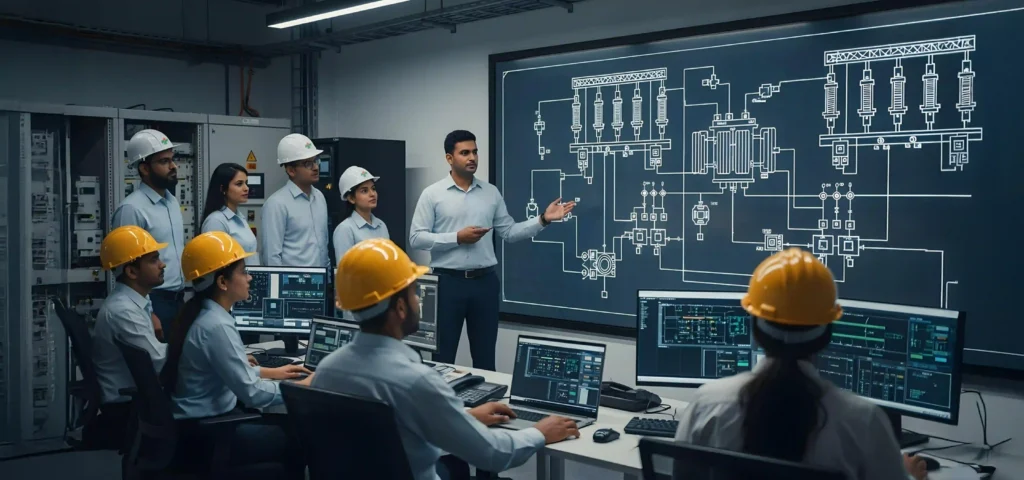
At Manav, Power System Analysis begins with understanding the real system, not an idealised diagram. Field data is verified against actual operating conditions, including load profiles, protection settings, and equipment characteristics. System models are built to reflect how the network truly operates, not how it was originally designed.
Load flow, short circuit, and protection coordination studies are performed as an integrated process, allowing interactions between different system elements to be accurately captured. Multiple operating and contingency scenarios are simulated, including future expansion cases, to ensure long-term resilience. Study results are validated through benchmarking and cross-checking against field performance, ensuring that analytical predictions align with operational reality.
This engineering-first approach ensures that analysis is not merely compliant but actionable, accurate, and future-ready.
Power System Analysis as a Continuous Engineering Requirement
Electrical networks are living systems. Loads evolve, operating patterns shift, equipment ages, and new technologies are introduced. As these changes occur, the electrical behaviour of the system changes with them. Power System Analysis must therefore be continuous.
At every stage of the asset lifecycle, analytical verification ensures that safety margins are maintained, protection remains selective, earthing systems remain effective, and regulatory compliance is preserved. Utilities, regulators, and insurers increasingly recognise that analysis is not a one-time deliverable but an ongoing engineering responsibility.

Conclusion
Power System Analysis is mandatory for industrial and utility networks because it is the only reliable method of validating safety, reliability, and compliance in modern electrical systems. Through Load Flow Study, Short Circuit Study, and Protection Coordination Study, it provides quantitative assurance that electrical networks can withstand faults, control energy, protect personnel, and maintain stable operation under all conditions.
In the absence of such analysis, electrical systems operate on assumption rather than evidence, exposing organisations to unacceptable safety risks, equipment damage, regulatory non-compliance, and operational instability. As power systems continue to grow in complexity and energy density, Power System Analysis is no longer optional. It is a fundamental engineering requirement for the long-term integrity of industrial and utility power networks.
– Author: Vigneshwaran S